
November 3, 2026
Gut Health and Weight: A Practical Guide to What the Research Supports
A hub for everything we've written on gut bacteria, prebiotic fiber, probiotics, and weight — what the research tends to support, what it doesn't, and how to read a label before you buy.
 AI-generated illustration
"Gut health" has become a label that gets attached to almost everything, which makes it hard to tell where the real research ends and the marketing begins. This guide is the map: what the gut-and-weight connection actually looks like, which bacteria and fibers keep coming up, what to expect from a supplement, and where each of our deeper articles fits. If you only read one page on this site before buying anything, make it this one.
The short version
The connection between gut bacteria and weight is real, but it's indirect. The bacteria living in your large intestine ferment fiber you can't digest, produce compounds that interact with appetite-related signalling, and influence how comfortable (or uncomfortable) your digestion feels day to day. Research has examined specific bacterial species and specific fibers in this context, and some of that research is promising. None of it shows that any bacteria, fiber, or supplement produces weight change on its own. The honest framing is that gut-directed habits and products are supporting tools that sit alongside sleep, protein, and movement — and that's the framing every article linked from this page uses.
How gut bacteria connect to appetite and weight
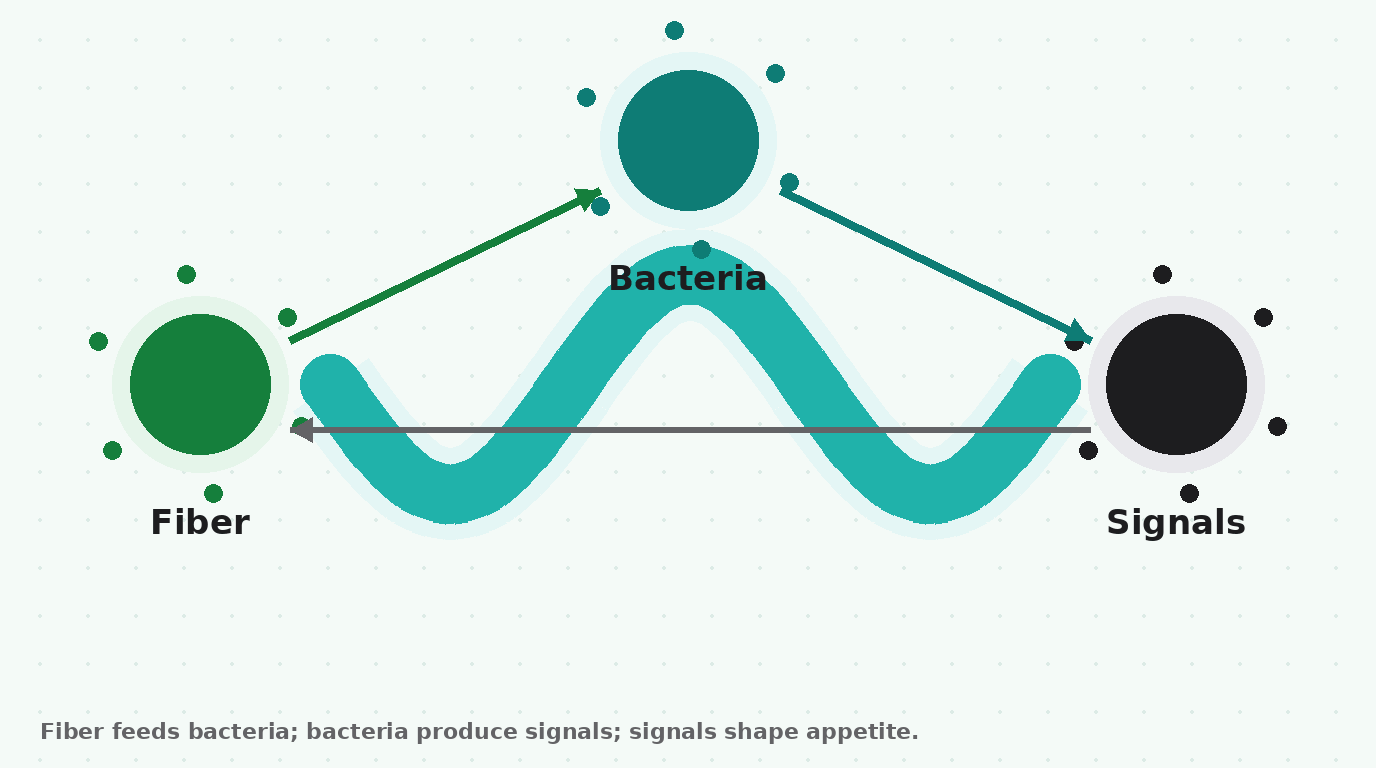
The most-studied mechanism runs through fermentation. When fiber reaches the colon undigested, bacteria break it down and produce short-chain fatty acids — butyrate, propionate, and acetate being the main ones. Butyrate is the primary fuel for the cells lining the colon. The others have been studied for the way they interact with receptors that influence hormones associated with fullness.
That's the chemical half. The other half is signalling. The gut and the brain communicate constantly through nerves, hormones, and immune messengers, and the bacterial population appears to influence what gets sent. We cover this in more depth in our article on gut bacteria and appetite signals, including why "feeling fuller on fewer calories" is a more accurate description of what the research examines than anything involving a metabolic shortcut.
Two caveats matter here. Study designs vary widely in dose, population, and duration, so results don't always replicate cleanly. And individual microbiome composition differs enough between people that the same intervention tends to produce different responses in different guts. Both are reasons to expect modest, variable effects rather than dramatic ones.
The bacteria that come up most in the research
Three species appear repeatedly in the metabolic-health literature, and all three appear on at least one label on our shortlist, so they're worth knowing by name.
Akkermansia muciniphila lives in the mucus layer lining the gut and has been a focus of research for over a decade, largely because of its association with the gut barrier. It's also one of the most over-hyped bacteria in supplement marketing. Our article on what the research on Akkermansia actually shows separates what's established from what's still preliminary.
Bifidobacterium infantis is best known as a strain that dominates the infant gut, which raises an obvious question about why it shows up in products for adults. The answer is more interesting than the marketing suggests, and we go through it in Bifidobacterium infantis in adult gut health.
Clostridium butyricum is, as the name suggests, a butyrate producer. Its research base is smaller than Akkermansia's but it keeps appearing in formulations aimed at weight management. We compare it with Akkermansia directly in our article on these two strains, including why strain-level research doesn't automatically transfer to a finished product.
The common thread across all three: the research tends to be strain-specific, dose-specific, and conducted in settings that don't always resemble taking a capsule at home. That doesn't make it worthless. It does mean a label listing a species name is a starting point, not a result.
Prebiotic fibers: resistant starch and chicory root inulin
If probiotics are the bacteria, prebiotics are their food, and this is where the research is on firmer ground, because fiber has been studied for a long time.
Resistant starch resists digestion in the small intestine and travels intact to the colon, where it's fermented into short-chain fatty acids. We explain the mechanism in resistant starch and gut bacteria, and because this is a fiber you can get from food, we also keep a practical list of resistant starch foods — cooled cooked potatoes, green bananas, oats, and legumes among them.
Chicory root inulin is one of the better-studied prebiotic fibers and is particularly associated with feeding Bifidobacteria. It also comes with the most honest trade-off on this page: because it ferments readily, a meaningful share of people experience gas or bloating, especially at higher doses or when starting suddenly. Our article on chicory root inulin's benefits and side effects covers the trade-off and the practical ways to manage it — starting low, splitting doses, taking it with food.
A pattern worth noticing: both fibers work because they ferment, and fermentation is also what causes discomfort. The dose and the pace of introduction matter more than the ingredient itself.
It's also worth saying that food comes first here. A supplement can add a measured amount of a specific fiber, which is useful if your diet is short on it, but it can't replicate the variety that comes from eating a range of plants. Fiber diversity — different types from different sources — is the habit the research keeps pointing back to, and it costs nothing beyond what's already in a grocery cart.
Probiotics, bloating, and what to expect
Two questions come up more than any others, and both deserve plain answers.
The first is whether probiotics help with bloating, which is complicated by the fact that new probiotic use can itself cause temporary gas as the bacterial population shifts. We work through what the evidence suggests, and for whom, in do probiotics help with bloating.
The second is timing. Gut-directed supplements don't produce a noticeable change in days, and anyone promising otherwise is selling something. The research on prebiotics and probiotics generally runs over weeks rather than days, and individual variation is real. How long before a gut supplement works sets a realistic expectation so you can judge a product fairly instead of giving up too early or persisting too long.
How to read a gut-health supplement label
This is where most of the value on this site concentrates, because the label is the one thing you can actually check before spending money.
The single most useful habit is looking for a proprietary blend. When a label groups ingredients under a blend name and gives one total weight, you can't tell whether any individual ingredient is present at a dose the research used. Our guide to supplement label red flags explains how to spot this and what else to look for: strain designations rather than bare species names, stated doses, and whether the claims on the front match the facts panel on the back.
We apply the same standard to everything we consider. How we evaluate weight-loss supplements lays out the three filters — evidence first, transparency, price sanity — and why most products never make it past the first one.
Where this fits with the basics
It would be dishonest to write a guide to gut health and weight without saying clearly that the gut is not where most of the leverage is. The research on metabolic rate and weight over time consistently points to muscle mass, sleep, protein intake, and daily movement as doing more of the work than any supplement. Our articles on why metabolism slows after 35 and why belly fat is stubborn after 40 go through those mechanisms, and both land in the same place: address the foundations first.
Gut-directed habits — more fiber diversity, gradual introduction, patience over weeks — fit alongside those foundations as a supporting layer. A supplement that discloses what it contains can be a reasonable part of that layer. It can't replace the layer underneath it.
We earn an affiliate commission when you buy through our links. That commission never influences what makes the shortlist — see our disclosure below.
Where Trimology fits in
Trimology is our current gut-directed pick because its label discloses each fiber and strain at a stated dose rather than inside a proprietary blend, which is the standard this guide asks you to apply to any product. It's a supporting tool alongside the basics above, not a replacement for them.
The bottom line
The gut-and-weight connection is real, indirect, and modest. Fiber fermentation and the bacteria that do it are tied to appetite signalling and digestive comfort in ways the research has examined for years, and a handful of species and fibers keep showing up for good reason. What the research doesn't support is any version of "take this and the weight changes." Read labels for stated doses, introduce fiber gradually, give a product weeks rather than days, and keep the basics — sleep, protein, movement — in the lead role. Every article linked from this page goes deeper on one piece of that picture.
These statements have not been evaluated by the Food and Drug Administration. The products discussed on this site are dietary supplements and are not intended to diagnose, treat, cure, or prevent any disease. Consult your physician before beginning any supplement program, particularly if you are pregnant, nursing, taking medication, or managing a medical condition. Individual results vary.